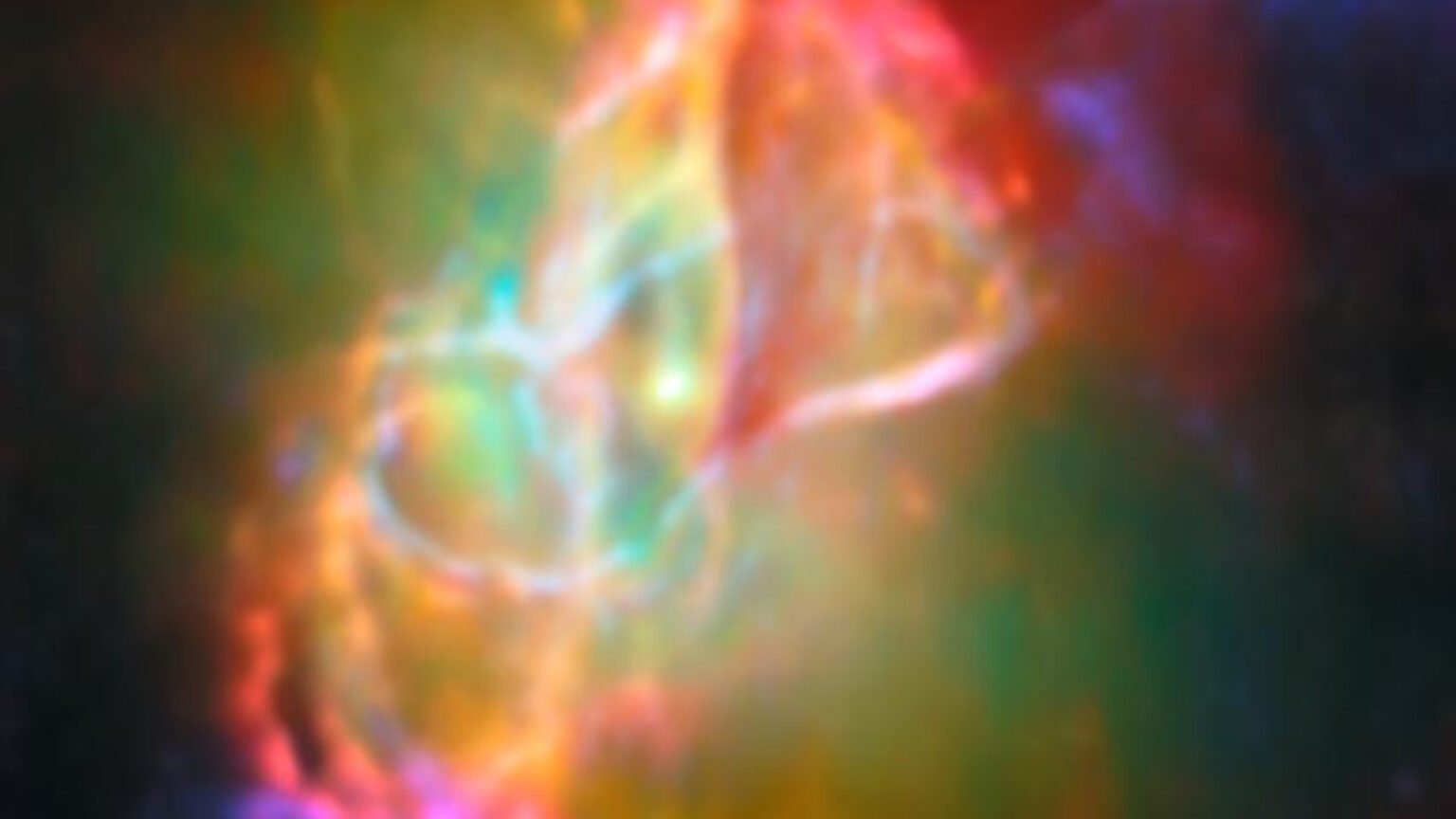

Cosmic dust particles that give birth to planets around young stars have for the first time been found forming — the James Webb Space Telescope has witnessed the creation of these tiny planetary building blocks around a dead star.
“This discovery is a big step forward in understanding how the basic materials of planets come together,” Mikako Matsuura of Cardiff University, who led the new James Webb Space Telescope (JWST) observations, said in a statement.
The Butterfly Nebula, also known as NGC 6302 and located about 3,400 light-years away in the constellation of Scorpius the Scorpion, is a planetary nebula — the celestial death blossom of a sun-like star that has run out of hydrogen in its core for nuclear fusion and has therefore expired. The outer layers of such a star would have puffed off into space, forming the nebula, while its super-hot core, radiating at 220,000 degrees Celsius (396,000 degrees Fahrenheit), was left behind as what we call a white dwarf.
The Butterfly is bi-polar, meaning we see two large lobes billowing out like wings. At their waist is what looks like the body of the butterfly, but is in fact a torus of dark dust seen edge-on.
The new JWST image, taken with its Mid-Infrared Instrument (MIRI) and supplemented with data from the ALMA radio telescope, targets that central torus. Interstellar dust typically is up to 0.1 microns (ten millionths of a meter) in size, but MIRI detected grains of crystalline silicate dust in the Butterfly Nebula’s torus that has a grain size of a millionth of a meter. This is tiny, but is still larger than typical interstellar grains and rather more comparable with the grains of dust found in star- and planet-forming regions. In such regions, dust sticks together in planet-forming disks around young stars, forming pebbles that gradually accrete into larger bodies and, eventually, planets. The existence of large dust grains is the beginning of that planet-building process.
Dust found in the molecular gas clouds that form new star systems comes from the deaths of previous generations of stars, and as that dust gradually spills out into interstellar space, it finds itself within the gas clouds that form new stars. However, the process of building larger dust grains that are ultimately the fundamental building blocks of planets had been somewhat mysterious — until now, that is.
“For years, scientists have debated how cosmic dust forms in space,” said Matsuura. “But now, with the help of the powerful James Webb Space Telescope, we may finally have a clearer picture.”
The size of the dust grains in the Butterfly Nebula suggests that they have been growing for a while, and they have grown at least in part thanks to chemical reactions energized by the exceedingly hot white dwarf at the center of the nebula. In particular, the JWST detected grains of quartz crystals in the Butterfly’s dusty torus.
“We were able to see both cool gemstones formed in calm, long-lasting zones and fiery grime created in violent, fast-moving parts of space, all within a single object,” said Matsuura.
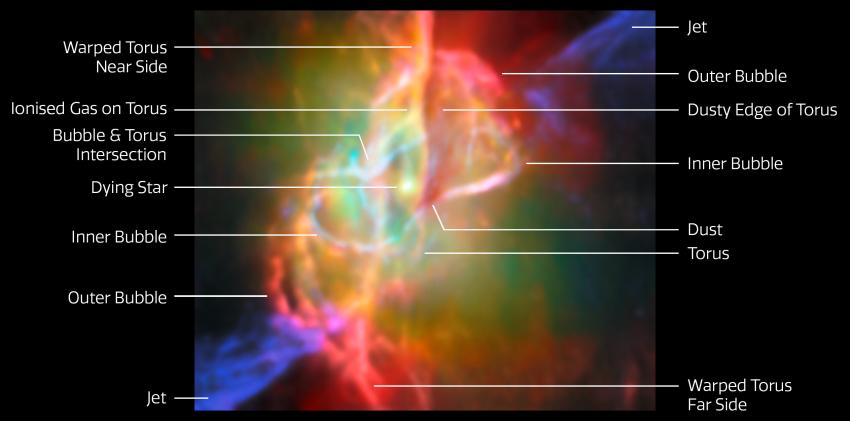
The JWST observations also detected common carbon-based molecules known as PAHs, or polycyclic aromatic hydrocarbons. These molecules are found on Earth in burnt toast and fumes from car exhausts, but they are also profusely present in deep space and are suspected of playing a key role in the chemistry of star- and planet-forming regions, and even in the prebiotic chemistry that can potentially lead to life as we know it. The PAHS exist in the Butterfly Nebula in flat ring-like structures possibly formed when bubbles of particles belched out by the white dwarf clash with the gas around it.
Over tens of thousands of years, the brilliance of the Butterfly Nebula will gradually disperse into deep space. The PAHs, quartz grains and other molecules formed from the death of a star will drift among the stars, looking for a new home in a gas cloud where it can help give birth to a new system of stars and planets.
The results of the JWST observations of the Butterfly Nebula were reported on Aug. 27 in the journal Monthly Notices of the Royal Astronomical Society.