
Polihali Dam will boost water transfers to Gauteng
- Construction of the Polihali Dam in Lesotho’s highlands is advancing after delays, with 30% of the main work completed, according to the Lesotho Highlands Development Authority.
- The huge dam will boost the water supply to Gauteng.
- About R18-billion of the R53-billion project has been spent.
Construction of Lesotho’s giant Polihali Dam, which will boost the water supply to Gauteng, is advancing after years of delays.
The dam in Mokhotlong is part of Phase II of the Lesotho Highlands Water Project. It is advancing after years of planning setbacks. By the end of July 2025, about M18-billion (R18-billion) of the project’s M53-billion budget had already been spent, according to the Lesotho Highlands Development Authority (LHDA) spokesperson Mpho Brown.
At the confluence of the Senqu and Khubelu rivers, the Polihali Dam will create a reservoir covering more than 5,000 hectares and holding 2,325-million cubic metres of water. Once completed, it is expected to boost annual water transfers to South Africa’s Gauteng region from 780 to 1,270-million cubic metres and raise electricity production at Lesotho’s ‘Muela hydropower plant from 500GWh to 800GWh per year.
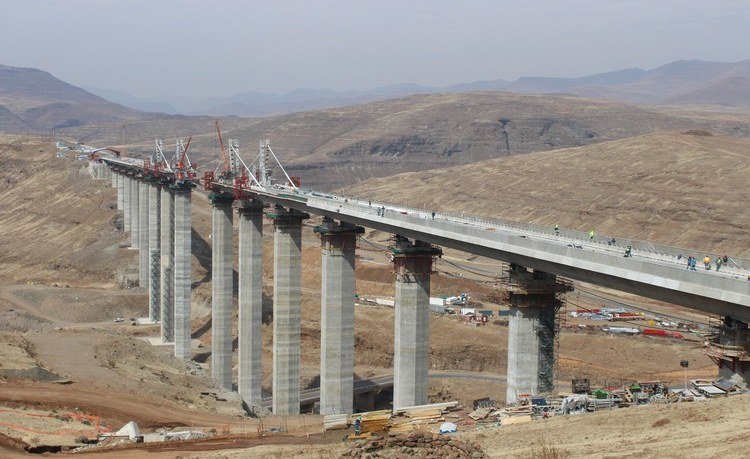
Addressing journalists during a media tour of the project last week, Brown said about 30% of the main dam works were complete by July. The M2-billion Senqu Bridge, one of the largest structures under the project, was already 86% finished.
Brown added that the project had created jobs for roughly 14,000 people, though he cautioned that it could not significantly reduce Lesotho’s 30% unemployment rate.
The Polihali Dam will create a reservoir covering more than 5,000 hectares and holding 2,325-million cubic metres of water and is expected to boost water transfers to South Africa and raise electricity production at Lesotho’s ‘Muela hydropower plant.
The development has reshaped life for thousands of people in the highlands. According to LHDA, more than 7,200 community assets have been expropriated, with M154-million paid in compensation for nearly 5,600 of them.
Koali Hlasoa, Senior Integrated Management Officer at LHDA Polihali Branch, said delays in outstanding payments were often linked to identification and ownership documentation problems, family disputes, or the absence of bank accounts. In some cases, beneficiaries had moved to South Africa for work, further slowing the process.
Alongside compensation, the project has been forced to manage environmental impacts. Chief Resident Engineer Ivano Vanzaghi, from the Matla a Metsi Joint Venture supervising the dam works, said contractors had so far generated 20,500 litres of waste oil, nearly 9,000 kilograms of other hazardous waste, and over 34,000 cubic metres of wastewater. More than 49 tonnes of general waste had been sent to landfill.
Communities have lodged complaints about dust, noise, air pollution, and water quality, while 40 environmental incidents have been reported. None were considered significant and the project supervisors are monitoring these reports, Vanzaghi said.
But delays have been harder to manage. The main dam fell behind schedule during site establishment, with slow excavation and hold-ups on tunnelling and spillway works. By late August, Vanzaghi said only 44 of 87 interior plinth blocks — structures that secure the dam wall — had been completed. Grouting of the external plinths had not yet begun.
Water impoundment, once scheduled for January 2025, has now been pushed back nearly two years to November 2026. Full completion of the dam and related works is expected between August and September 2029.
Three major bridges — Senqu, Khubelu and Mabunyaneng — are under construction to maintain road access across the reservoir once it fills. The existing crossings on the A1 Road will be submerged under water.
The Senqu Bridge, the largest and most complex, costs M2.3 billion and will stretch 825 metres across the reservoir at a height of 90 metres.
Construction, awarded to the WRES Senqu Bridge Joint Venture made up of firms from Lesotho, South Africa, Italy, Austria and France, began in late 2022. Originally set for completion in November 2025, it is now expected in February next year.
Louis Joubert of Zutari, the consulting engineers overseeing the bridges, said early delays were caused by design changes, operational problems, severe winds, labour strikes and blockages by local communities. He stressed that the bridge had been designed to withstand floods and earthquakes and should last at least a century.
The two smaller bridges, Khubelu and Mabunyaneng, are two-thirds complete.
Meanwhile, work continues on the 38-kilometre transfer tunnel that will connect Polihali to the Katse Dam, allowing the volumes of water tunnelled to South Africa to increase. Two massive tunnel boring machines imported from China will start digging from both ends, each boring 17.2km until they meet in the middle.
The Katse side tunnel boring is scheduled to begin early next year, with the Polihali side to follow later in 2026.