


September 29, 2025
2 min read
Weaver Ants Form Complex Chains to Pull More Than 100 Times Their Weight
With each member added to a team, humans do less work—but weaver ants do better and better
imageBROKER.com/Alamy Stock Photo
Weaver ants’ feet have an incredibly strong grip—individual members of one species can, without slipping, hold an entire dead bird hanging off the edge of a table. And the mighty insects rarely work alone, often teaming up to haul and fold oversized leaves as they build their foliage-filled homes. Scientists have now found that as teams of Asian weaver ants gain more members, they strategically use their grippy feet to become ever more efficient at pulling leaf tips. In contrast to typical human behavior, ants work harder in larger groups than when alone to pull comparatively huge weights.
In a measurable phenomenon called the Ringelmann effect, the more humans join a team, the less effort each individual member tends to exert; researchers generally attribute this to reduced motivation and the difficulty of coordinating more people. “When you’re pulling on a rope, like a tug-of-war, it’s actually less efficient to have more people lined up,” says Macquarie University biologist Chris Reid, co-author on a new study in Current Biology.
Reid and his colleagues connected the tip of a paper leaf to a force-measuring device and filmed weaver ants pulling the tip back across the leaf to fold it. They found single ants pulled 59 times their weight on average, but individuals in groups of 15 pulled 103 times their weight. The more ants were included, the sharper the efficiency increase.
On supporting science journalism
If you’re enjoying this article, consider supporting our award-winning journalism by subscribing. By purchasing a subscription you are helping to ensure the future of impactful stories about the discoveries and ideas shaping our world today.
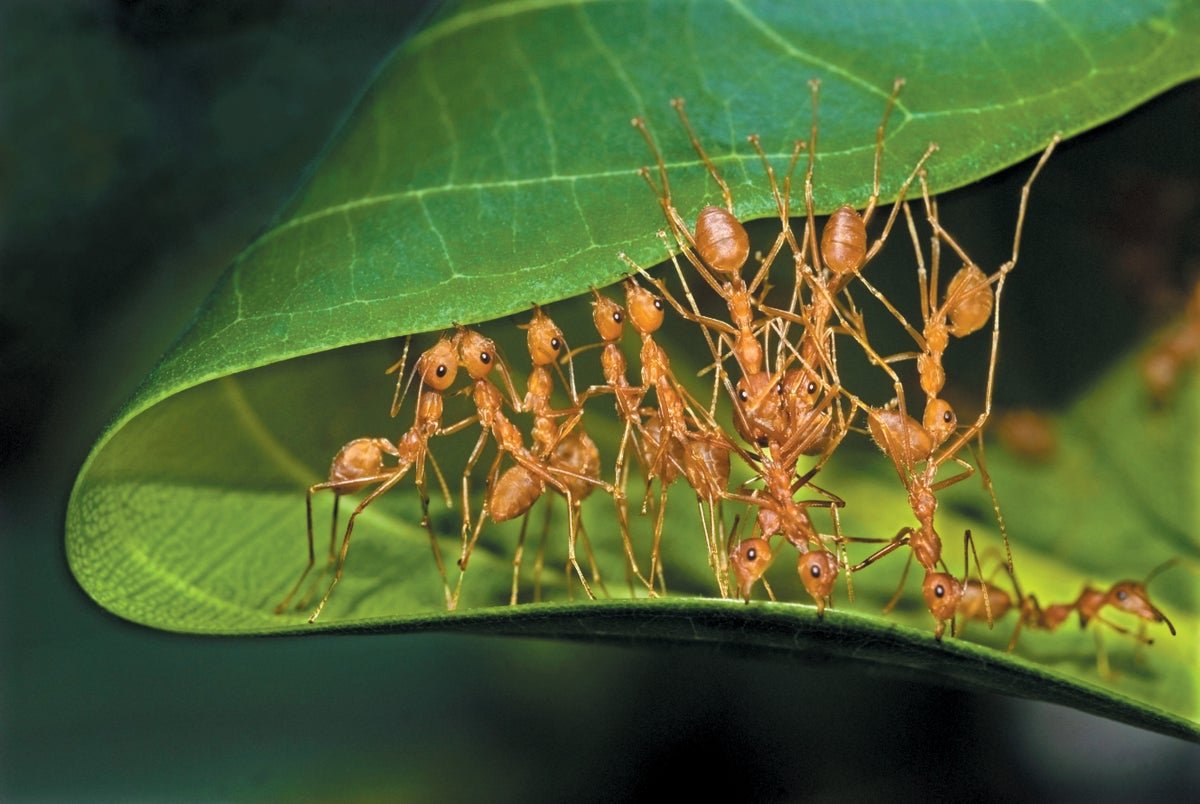
To make this happen, the ants assembled into chains of two to four, one behind the other. The front ants bent their legs and pulled hard at the leaf tip with their mandibles while the rear ants held the leaf still.
The researchers propose these pulling chains could act like force ratchets. The front ants are “active pullers,” and the rear ants are the “passive resisters”—they grab on to the front ants’ bodies, plant their sticky feet firmly on the leaf, and store the forces generated by the front ants so the leaf doesn’t fly backward.
“Examples of true superefficiency are very limited,” says ecologist Scott Powell of George Washington University, who was not involved in the study. Marching army ants strictly following a pheromone trail to carry heavier loads are another known example. But along with efficient coordination, weaver ants’ physical traits appear to give them an edge.
These ants’ unusually grippy feet make them “really well adapted to withstanding a strong pulling force in the other direction,” says biologist Helen McCreery of Tufts University, who also was not involved in the study. “The world is full of organisms solving problems in ways that are totally different from the way our brains would think to do it.”
It’s Time to Stand Up for Science
If you enjoyed this article, I’d like to ask for your support. Scientific American has served as an advocate for science and industry for 180 years, and right now may be the most critical moment in that two-century history.
I’ve been a Scientific American subscriber since I was 12 years old, and it helped shape the way I look at the world. SciAm always educates and delights me, and inspires a sense of awe for our vast, beautiful universe. I hope it does that for you, too.
If you subscribe to Scientific American, you help ensure that our coverage is centered on meaningful research and discovery; that we have the resources to report on the decisions that threaten labs across the U.S.; and that we support both budding and working scientists at a time when the value of science itself too often goes unrecognized.
In return, you get essential news, captivating podcasts, brilliant infographics, can’t-miss newsletters, must-watch videos, challenging games, and the science world’s best writing and reporting. You can even gift someone a subscription.
There has never been a more important time for us to stand up and show why science matters. I hope you’ll support us in that mission.


