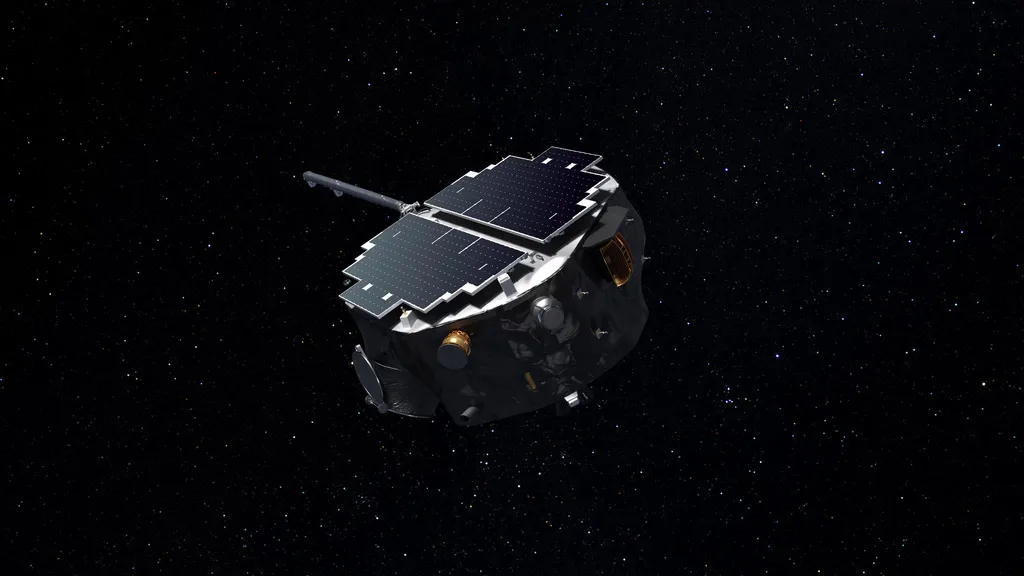

SpaceX is preparing to launch three spacecraft on a first-of-its-kind mission to study the sun’s influence throughout the solar system, from Earth’s atmosphere to the edge of interstellar space.
A Falcon 9 rocket is scheduled to lift off from Launch Complex-39A, at NASA’s Kennedy Space Center in Florida, on Sept. 23 at 7:32 a.m. EDT (1132 GMT). Stowed inside Falcon’s payload fairing are NASA’s Interstellar Mapping and Acceleration Probe (IMAP), the Space Weather Follow-on (SWFO-L1) spacecraft from the U.S. National Oceanic and Atmospheric Administration (NOAA), and NASA’s Carruthers Geocorona Observatory.
The satellite trio is bound for the Earth-sun Lagrange Point-1 (L1), an orbitally stable location in permanent sunlight that lies 930,000 miles (1.5 million kilometers) from Earth. Though each mission has its own distinct objectives, their combined science is designed to build a more complete picture of the Earth-sun relationship.
IMAP is the first spacecraft dedicated to mapping the outer boundary of the heliosphere, the vast magnetic bubble surrounding our solar system that’s formed by the solar wind. The satellite’s 10 instruments, built by teams across the U.S. and with contributions from 27 international partners, will measure solar wind, interstellar dust and charged particles, while also providing continuous solar weather monitoring.
IMAP and its companions will be the first spacecraft to observe solar activity from their L1 vantage point, and are designed to offer between 30 minutes to an hour of advanced warning of dangerous radiation storms headed for Earth.
This is particularly important for astronaut missions beyond low Earth orbit (LEO), which won’t enjoy much radiation protection from Earth’s magnetosphere. And NASA aims to launch two such missions soon — the Artemis 2 flight around the moon in 2026 and Artemis 3 lunar landing mission in 2027.
“IMAP will provide warnings beginning with Artemis 2 and Artemis 3 of incoming harmful radiation storms faster than any other spacecraft has done before,” Nicky Fox, associate administrator of NASA’s Science Mission Directorate, told reporters during a press conference on Sept. 4.
David McComas, principal investigator for the mission, said IMAP data “will help us better understand the fundamental physics of the heliosphere” and how it shields Earth and spacefarers from cosmic rays.
Riding alongside IMAP, NOAA’s SWFO-L1 will serve as a dedicated solar alert system, monitoring space weather and energetic particles in real time. Its data will feed directly into NOAA’s forecasting models to help safeguard satellites, communications systems and power grids from geomagnetic storms.
NASA’s Carruthers Geocorona Observatory — previously known as the Global Lyman-alpha Imagers of the Dynamic Exosphere (GLIDE) — is tasked with studying Earth’s exosphere, a thin atmospheric layer that extends nearly halfway to the moon.
“We actually don’t know exactly how big it is,” said University of Illinois scientist Lara Waldrop, the mission’s principal investigator. “We don’t know whether it’s spherical or oval, how much it changes over time, or even the density of its constituent hydrogen atoms.”
Waldrop said what we do know is that the exosphere plays a critical role in Earth’s response to geomagnetic storms. L1 sits outside the exosphere, providing mission operators a rare chance to measure it from the outside.
Findings will also improve scientists’ understanding of how atomic hydrogen escapes Earth’s gravity and inform models of planetary evolution in the search for habitable exoplanets.